
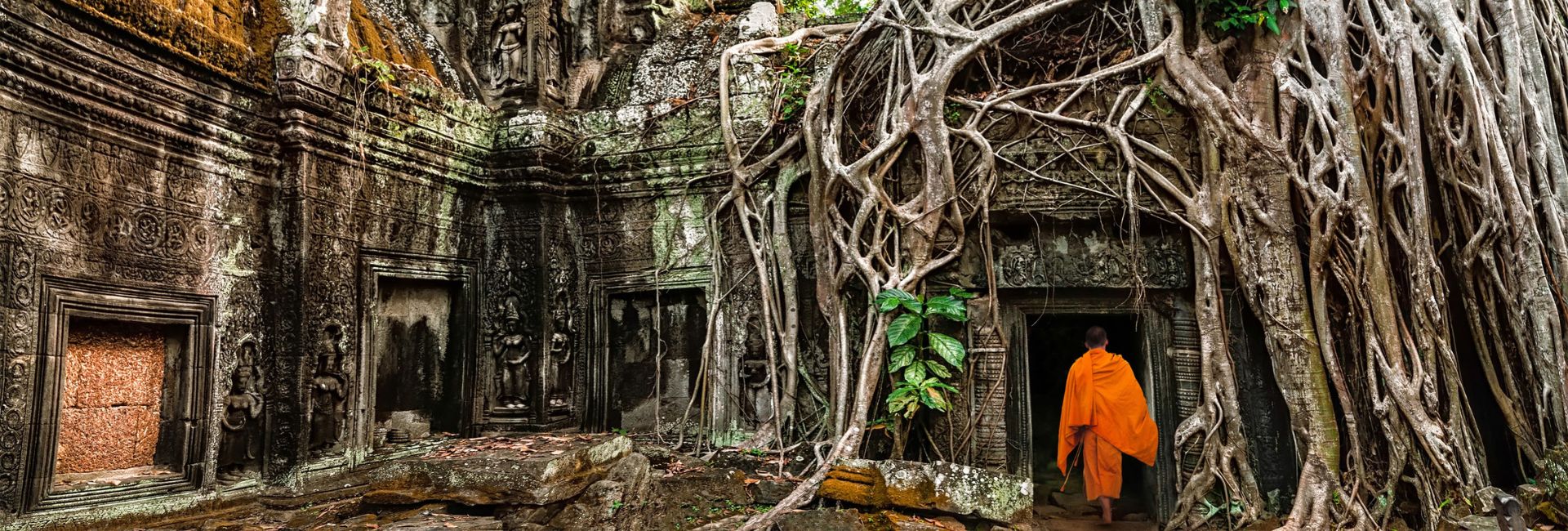
Among the many temples scattered across the Angkor Archaeological Park, Ta Prohm is the one that feels like a secret the jungle never quite gave up. Ancient roots snake across crumbling stone walls, doorways are framed by trees that seem to be slowly swallowing the ruins whole, and the whole place carries a mystical, slightly eerie beauty you won’t find anywhere else in Cambodia.
Built in 1186 AD and left largely as the jungle reclaimed it, Ta Prohm is one of the few Angkor temples that hasn’t been “cleaned up” for visitors – and that’s exactly why people love it. The place creates a mystical and secretive feeling during your Cambodia tours.
Quick answers, if you’re short on time:
- How old is it? About 840 years old, built in 1186 AD.
- Where is it? Inside Angkor Archaeological Park, ~12 km from Siem Reap, just east of Angkor Thom.
- What’s it known for? Giant tree roots swallowing the ruins, and its starring role in Tomb Raider (2001).
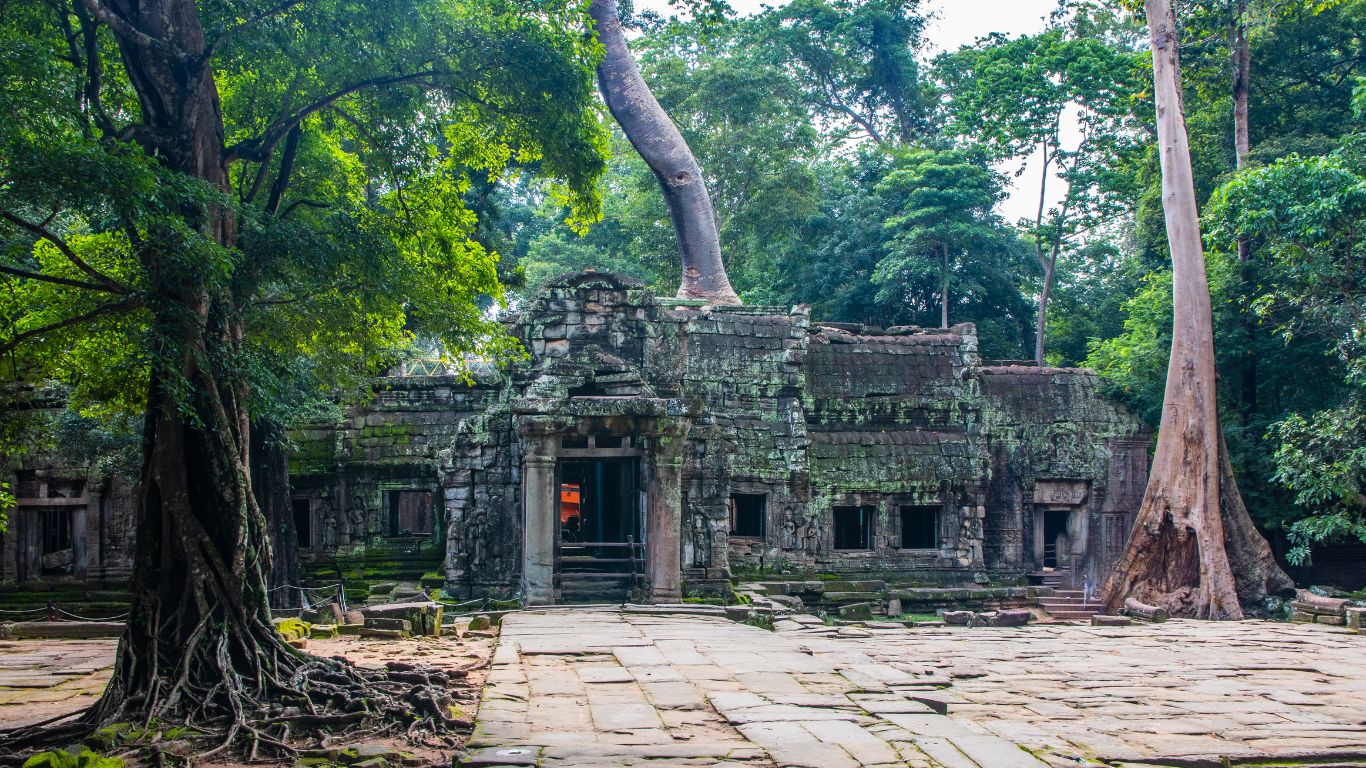
Where Is Ta Prohm Temple?
Ta Prohm sits inside the Angkor Archaeological Park in Siem Reap Province, Cambodia – about 12 km northeast of Siem Reap city, just east of Angkor Thom, and roughly 3 km northeast of Angkor Wat (coordinates: 13°26′06″N, 103°53′21″E). It’s a separate temple from Angkor Wat, but the two are easy to combine in a single day since they share the same park entrance ticket. Details on how to actually get there are in the getting there section further down.
Ta Prohm History
Ta Prohm isn’t part of Angkor Wat — it’s its own temple complex within the larger Angkor Archaeological Park, built later, for a very different purpose.
King Jayavarman VII founded it in 1186 AD as a Mahayana Buddhist monastery and school, originally named Rajavihara (“Monastery of the King”). At its peak, the complex supported nearly 13,000 people — monks, priests, students, maids, and dancers – making it as much a university town as a temple. Its central image, representing Prajnaparamita (the personification of wisdom), was modeled on the king’s own mother, which is why locals also came to know it as the “Queen’s Tomb.”
Legend has it the temple once held staggering wealth: several tons of gold dishes, hundreds of silk beds and ceremonial umbrellas, dozens of precious stones. Whether the numbers were exaggerated to honor the king or not, little of it survives today – when the Khmer capital fell to Siamese forces in the 15th century, the royal court fled to Phnom Penh, and the temple’s valuables were looted. All that’s left are the empty stone niches where they once sat.
After that, Ta Prohm simply disappeared into the jungle for nearly 400 years, forgotten until French naturalist Henri Mouhot came across it in 1860. Unlike Angkor Wat, which was never abandoned and later fully restored, Ta Prohm has deliberately been left in this half-reclaimed state – which is exactly what makes walking through it today feel like stepping into a temple time forgot.
For comparison: Angkor Wat is a separate, earlier complex, completed around 1150 AD under King Suryavarman II as a Hindu temple dedicated to Vishnu, later adapted for Buddhist worship. Both temples are part of the same Angkor Archaeological Park, but they were built decades apart, by different kings, for different gods.
What can you expect when coming? Inside Ta Prohm Temple
The Iconic “Tomb Raider” Experience
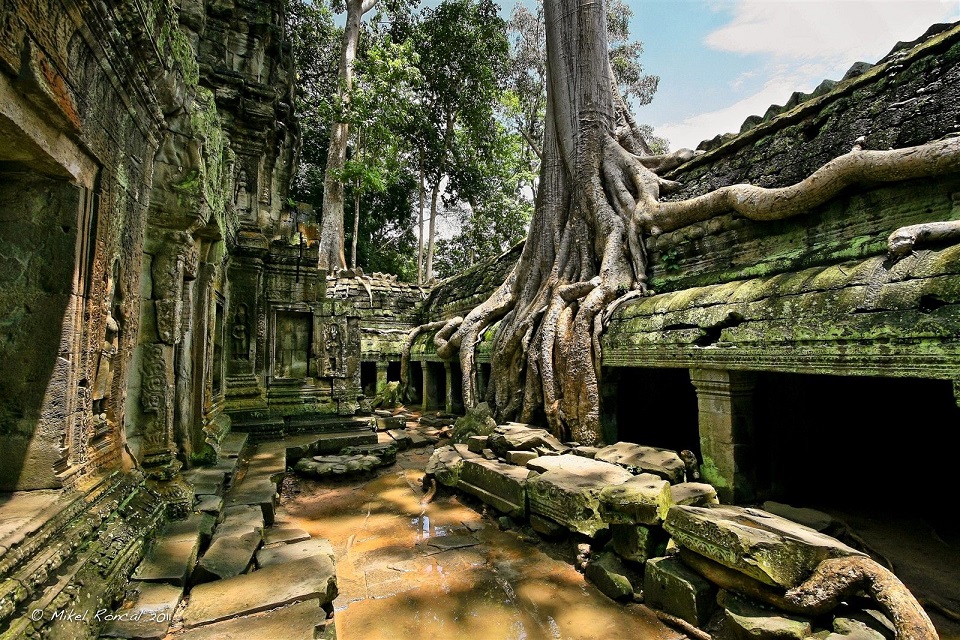
Ta Prohm is famous for its dramatic appearance in the 2001 film “Lara Croft: Tomb Raider.” You’ll encounter the exact atmospheric ruins where massive silk cotton trees (cecropia) and strangler figs have grown through and around the ancient stone structures, creating one of Cambodia’s most photographed and Instagram-worthy locations.
Architectural Fusion with Nature
Unlike other restored Angkor temples, Ta Prohm has been deliberately left in a semi-ruined state. Expect to see enormous tree roots cascading over doorways, walls split apart by growing trunks, and corridors where stone and living wood intertwine. The most famous spot is the “Tomb Raider Tree” – a massive spung tree whose roots dramatically frame a doorway.
>>> Suggested tour to Ta Prohm: Classic Angkor 4 Days
Layout and Exploration
The temple complex covers 39 hectares and follows a typical Khmer layout – a series of single-story rectangular galleries arranged concentrically. At its full recorded scale, the complex included 260 deity statues, 39 pinnacled towers, and 566 stone residences, all enclosed within a perimeter wall measuring 600 by 1,000 meters.
2026 update – South Gate restoration:
Some corridors and towers are currently roped off for ongoing restoration work, so a few sections may be inaccessible depending on when you visit – that’s normal, not a sign you’re missing the “real” temple.
- The South Gate of Ta Prohm is undergoing restoration by ANA (Cambodia) and the Archaeological Survey of India, part of a project that started in 2023.
- As of mid-June 2026, it’s about 75% complete, using the anastylosis technique — dismantling the structure and reassembling it with its original stones.
- It’s expected to be fully completed by the end of 2026, so if you’re visiting this year, expect to see some scaffolding or roped-off sections around the South Gate specifically – the rest of the temple, including the Hall of Dancers and the Tomb Raider Tree, remains fully open.
Practical note: Plan for 1.5 to 2 hours to explore the full complex. Some sections are under ongoing restoration and may be closed during your visit. A local guide is strongly recommended to avoid getting lost in the labyrinthine corridors and to fully appreciate the architectural details and symbolism throughout.
>>> Read more: 15 Things to do in Siem Reap – Beside visiting Angkor Wat
How to Include Ta Prohm in Your Itinerary
A common mistake independent travelers make is trying to cram Angkor Wat, Angkor Thom, and Ta Prohm into one exhausting day. Looking at how our own multi-day itineraries actually pace it, the pattern that works best is simpler: give Angkor Wat and Angkor Thom their own full day, and give Ta Prohm a separate day or half-day paired with something else nearby.
Here’s what that looks like in practice, pulled from real itineraries we run:
- Option 1:
Angkor Wat + Angkor Thom (Bayon) – One full day: Sunrise at Angkor Wat, then the South Gate of Angkor Thom, Bayon, the Royal Enclosure, and the Terrace of the Leper King – this alone is a full day of walking and easily stands on its own, as seen in our Discovery Southern Vietnam & Cambodia 13 Days itinerary.
Ta Prohm + Banteay Srei + Banteay Samre – A separate day: In that same 13-day itinerary, Ta Prohm is visited the next day, in the afternoon, after the morning is spent at Banteay Srei (the pink sandstone temple) and Banteay Samre. This groups Ta Prohm with temples that share its intricate carving style rather than rushing it in behind Angkor Wat.
- Option 2:
Ta Prohm + Tonle Sap Lake – A natural half-day pairing: In both our Far East Discovery 22 Days and Splendors of Vietnam & Cambodia 17 Days itineraries, Ta Prohm is visited alongside nearby small-circuit temples (Banteay Kdei, Ta Keo, Thommanon) in the morning, then followed by a boat tour of Tonle Sap’s floating villages in the afternoon – a nice contrast after hours of walking through stone ruins.
Why this pacing works better than combining everything?
Angkor Wat and Ta Prohm are both large, slow, walk-heavy sites – stacking them into one day means you’re rushing the second one just as the heat peaks. Splitting them across two days (or a full day plus a half-day) means you actually get to stand in the Hall of Dancers instead of speed-walking past it because your tuk-tuk driver is waiting.
If you’re planning it yourself, a good rule of thumb: budget one full day for Angkor Wat + Angkor Thom, and a separate half-day for Ta Prohm paired with either Banteay Srei or Tonle Sap Lake, depending on whether you want more temples or a change of scenery. Three days in Siem Reap comfortably covers the Small Circuit, the Grand Circuit, and Banteay Srei without feeling rushed.
Would rather not plan the sequencing yourself? This is honestly where a lot of independent travelers lose time – bouncing between temples out of order, hitting crowds at the wrong hours, or missing a site because the logistics got complicated. We also run private, fully customized Angkor tours – your own guide and driver, a pace built around how you actually want to spend your days, and none of the fixed scheduling that comes with a group tour. If you want to get the quotation, simply fill out this form or email at info@indochinavoyages.com.
How to get to Ta Prohm
| Transport | Cost | Travel Time from Siem Reap | Best For |
|---|---|---|---|
| Bicycle | Free – $10/day (rental) | ~80 minutes | Active travelers, scenic route |
| Tuk tuk | $15 – $25/day | ~30 minutes | Groups up to 4, most popular option |
| Private car | $35 – $50/day | ~14 minutes | Families, hot season, multi-temple days |
By bicycle
The cheapest way to get around Siem Reap is by bicycle, which may be free at your hotel or hostel or if rented, the rent free is from US$3 – 10 per day depending on types and quality of bike. Please be prepared for a long ride if you want to combine Ta Prohm temple with other temples. Since the weather in Siem Reap is quite hot and humid, please bring enough water with you.
By tuk tuk
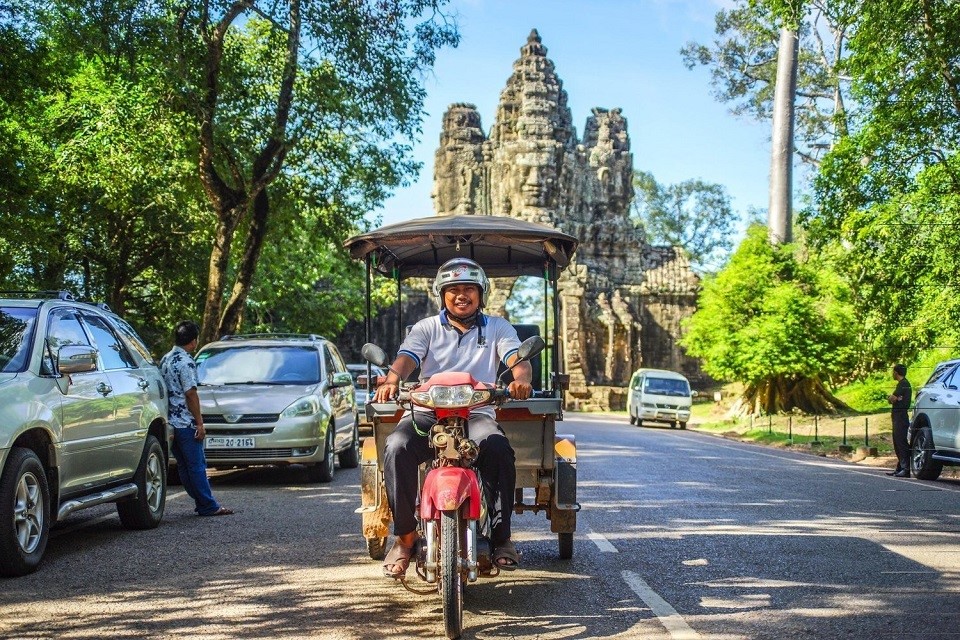
Tuk tuk seems to be the most convenient way to get around Cambodia, especially in Siem Reap. You can easily find tuk tuk drivers everywhere along the side of the road in Siem Reap. The price ranges from US$15- 25 per day for temples located near by the city center. A tuk tuk can hold up 4 people so you can always split the cost between friends. Most of tuk tuk drivers can speak English and know where to take you to.
By private car
If your budget allows, the most convenient way is to get a private car with A/C, especially if you are going to visit places far from center such as Kulen Mountain or Beng Mealea. Depending on the number of people in your group and how many temples you visit, the cost is around US$35 – 50 per day. Furthermore, private car is a good way to combine your visit to Ta Prohm temple with Angkor Complex, Roluos group or Beng Mealea.
>>> Suggested tour to Ta Prohm: Siem Reap In Depth 5 Days
Travel Tips Information
Ta Prohm entrance fee
Ta Prohm has no separate admission fee it is included in the Angkor Archaeological Park pass:
| Pass Type | Price | Validity |
|---|---|---|
| 1-Day Pass | $37 per person | Valid for 1 day only |
| 3-Day Pass | $62 per person | Valid for 7 days; use on any 3 days |
| 7-Day Pass | $72 per person | Valid for 1 month; use on any 7 days |
Tickets are checked at every temple entry point. Always carry your valid pass with you throughout the day.
Ta Prohm opening hours
* Ta Prohm is open daily from 5:00 AM to 6:00 PM.
* The best time to visit is between 5:00 AM and 7:30 AM, before crowds arrive and while the air is still cool.
* While most visitors head to Angkor Wat for sunrise, you can enjoy a far quieter and more atmospheric Ta Prohm entirely to yourself in those early hours.
Best time of year to visit Ta Prohm temple
The dry season (November to April) offers the easiest travel conditions: less rain, dry paths, and clear skies. The wet season (May to October) brings lush green surroundings and cooler temperatures, but pathways inside the temple can become slippery. Avoid visiting between 8:00 AM and 11:00 AM, which is peak crowd time regardless of season.
Dress Code Requirement
- What to wear in Cambodia? During your visit to temple, make sure your legs and shoulders are covered.
- Since Cambodia is hot all year around, make sure to bring enough water with you.
- Wearing good walking shoes during your visit in all temples in Angkor.
- You can get to the temple and visit it by yourself, but it is always much better to have a guide escorted to explain everything for you. It would be much more meaningful for your exploration.
- Wearing colored clothes will give you a good picture as it is against the dark grey backgrounds.
Ta Prohm Temple at Tonle Bati
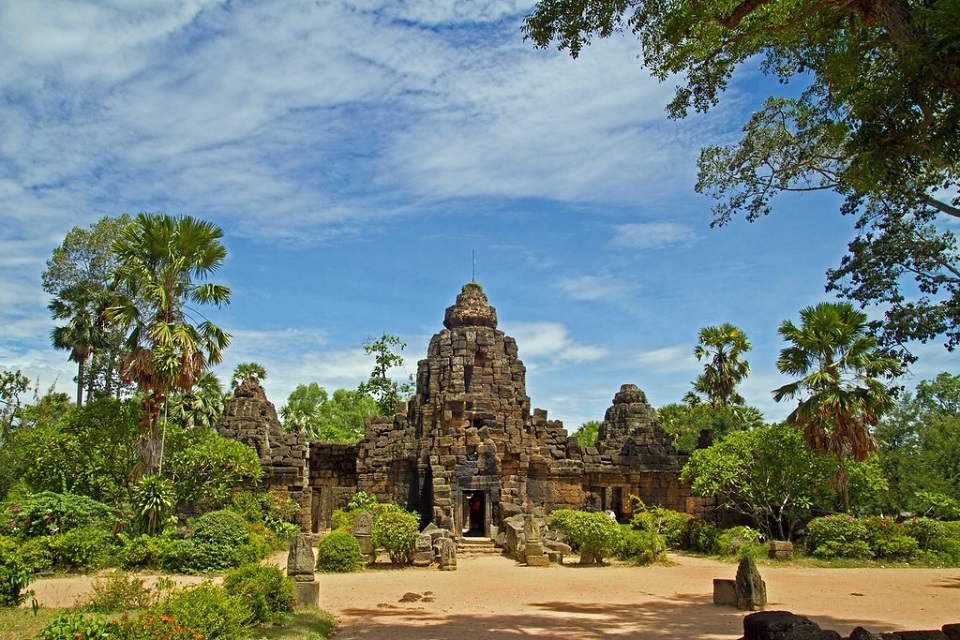
Being built the same time with Ta Prohm Temple in Angkor by famous King Jayavarman, Ta Prohm Temple at Tonle Bati was a sanctuary for Hindu deities at the same time. Since the sixth century, this place used to be a Hindu place of worship, which belonged to the maritime “empire”. The temple was located on the road to Tonle Bati, a small lake and popular picnic spot for the locals. You can get there by local buses from Phnom Penh or rent a private vehicle to explore this temple and the surrounding nature.
Suggested Cambodia itinerary including Ta Prohm temple
Frequently Asked Questions
How old is Ta Prohm temple? About 840 years old – it was founded in 1186 AD by King Jayavarman VII.
Where is Ta Prohm temple? Inside the Angkor Archaeological Park in Siem Reap, Cambodia – about 12 km from Siem Reap city, just east of Angkor Thom.
What’s inside Ta Prohm temple? A central sanctuary, the 48-pillar Hall of Dancers, dozens of towers and shrines, a 1186 AD foundation stele, and the giant tree roots the temple is famous for – including the “Tomb Raider Tree.”
Is Ta Prohm part of Angkor Wat? No, they’re separate temples within the same Angkor Archaeological Park. Angkor Wat came first, built as a Hindu temple; Ta Prohm followed decades later as a Buddhist monastery.
How much time should I plan for Ta Prohm? 1.5-2 hours covers the highlights comfortably; longer if you want to explore in real depth or bring a guide.
Do I need a separate ticket for Ta Prohm? No, it’s included in the standard Angkor Archaeological Park pass, which also covers Angkor Wat, Angkor Thom, and the rest of the temples.
Van Do – Travel Specialist